
Ask any organiser what went wrong at their first auction and the story usually starts weeks before auction night. A player list full of blanks. Twenty photos missing. A star bowler listed as a batter because the form never asked. Registration is the least glamorous part of running a player auction and it decides more of the evening than anything else you do.

The auction itself is a performance built entirely on data you collected earlier. Every player who walks up on screen is introduced by whatever the registration form captured. If the form was thin, the auctioneer has nothing to say and captains are bidding blind. This guide covers the four things that matter: timing, fields, photos and categories.
Open registration early and close it properly
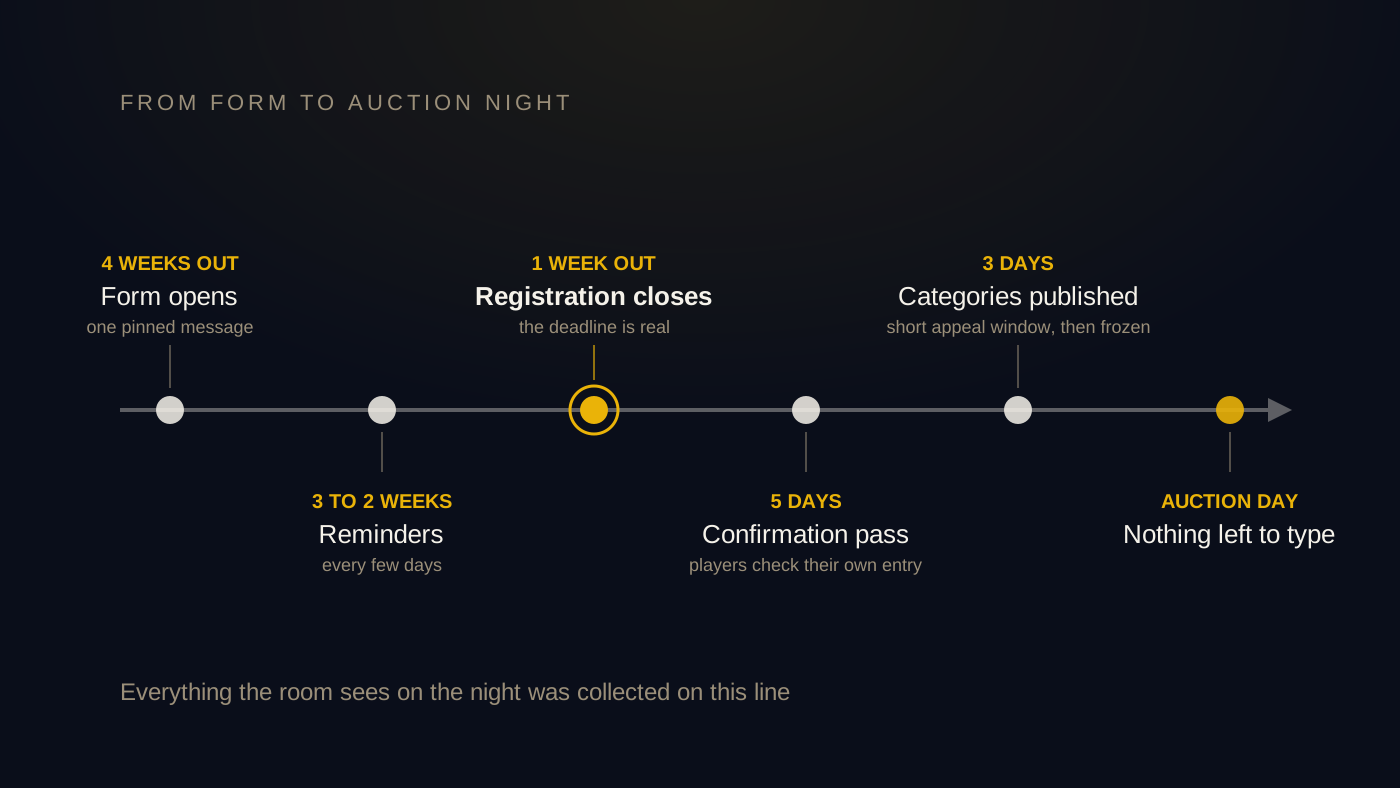
The single best registration decision is a real deadline, set at least a week before auction day and actually enforced.
Open registration three to four weeks out. Any earlier and people forget they signed up. Any later and you spend auction week chasing stragglers instead of preparing the event. Share the form everywhere your players already are, which for most leagues means one pinned message in the tournament group and a reminder every few days.
Then close it. The painful part of a deadline is the friend-of-a-friend who asks to join two days after it passed. Decide your policy in advance: either a hard no, or late entries go straight into the lowest category at the minimum base price with no exceptions. Both are fine. Deciding on the spot is not, because whatever you decide becomes precedent in front of forty people.
Expect a small gap between registrations and reality. A handful of registered players will pull out and one or two will turn out to be duplicates. Build a confirmation pass into the final week: publish the full registered list and ask everyone to check their own entry. Players are remarkably fast at spotting their own name spelled wrong and remarkably slow at telling you anything else, so this one pass catches most errors free of charge.
The fields that matter, and the ones that do not
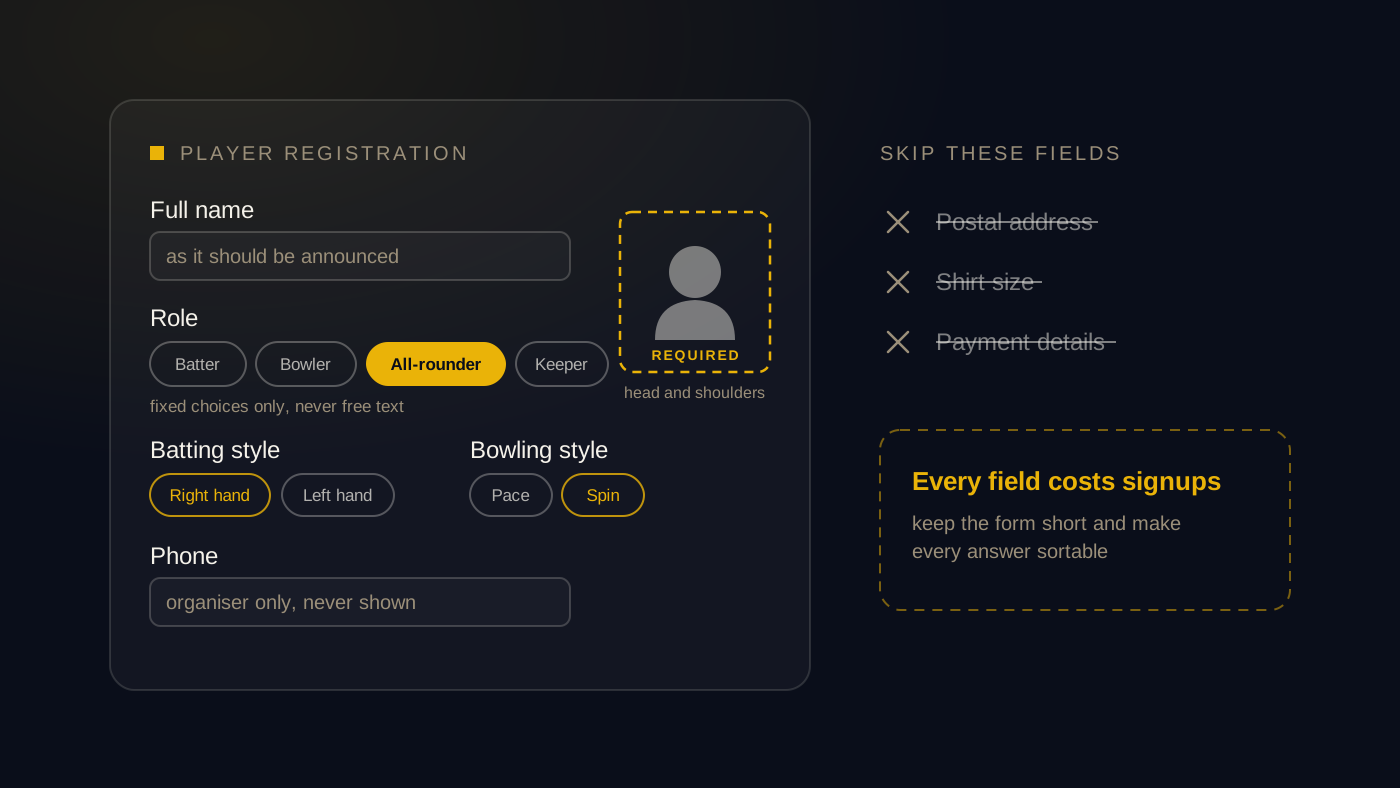
A registration form is a trade. Every extra field costs you completed registrations, so each one has to earn its place. For a cricket auction the core set is short:
- Full name. As they want it announced. Ask exactly that, because "name as it should be read out at the auction" gets you better answers than "name".
- Role. Batter, bowler, all-rounder or wicketkeeper. This is the field captains build squads around, so make it a fixed choice, never free text. Free text gets you "bits and pieces cricketer" and other answers you cannot sort by.
- Batting style and bowling style. Right or left handed, pace or spin. Two small fields that give the auctioneer an introduction and give captains a reason to bid. A left-arm spinner is worth a premium in most leagues and the form is how anyone finds out he exists.
- Phone number. For the organiser only, never displayed. You will need to reach players about timings and team assignments.
- A photo. Covered properly below.
Fields to skip: postal addresses, shirt sizes, payment details and anything you can collect after teams are picked. A long form does not make an auction better. It makes a shorter player list.
If your auction is not cricket, the core set is the same with the sport-specific fields swapped. A volleyball league wants position and height. A football league wants preferred position and strong foot. A kabaddi league wants raider or defender. This is where custom fields matter: AuctionXI lets you define your own player fields per tournament, so a badminton league and a box cricket league can each capture exactly what their captains bid on rather than forcing everything into cricket-shaped boxes.
One collection tip that saves hours: however you collect responses, get them into a single spreadsheet with one row per player and fixed choices for every sortable field. If your auction tool supports bulk import from Excel, match your form columns to its template from day one. AuctionXI imports your whole player list from Excel in one pass, with photos mapped to players automatically, so a clean sheet becomes a loaded auction in minutes. If you are building that sheet by hand, our cricket auction Excel template gives you a working structure to start from.
Photos: the difference between a list and an event
Here is the honest case for photos. On auction night, each player appears on the big screen in front of the whole room. A name in plain text is admin. A face with a name is a moment. Players sit up when their own photo fills the projector, and the room bids differently when it can see who it is bidding on. If you are putting your auction on a screen at all, and you should be, photos are what make it feel like the real thing.
Getting usable photos is a known battle, so fight it with rules rather than reminders:
- Make the photo a required field on the form itself. A photo chased later has a collection rate of roughly whoever you can corner at practice. A photo required at registration has a collection rate of everyone who registered.
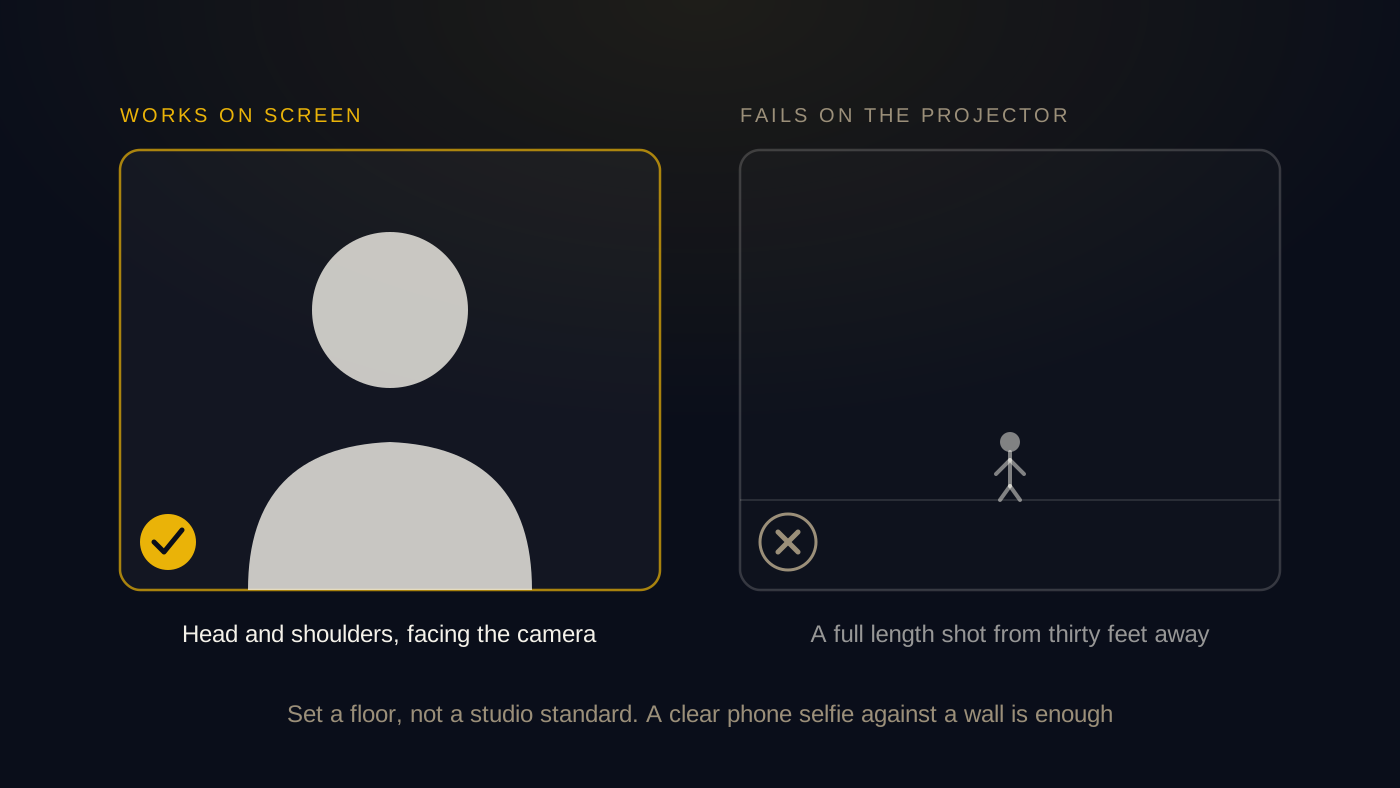
- Ask for a specific shape. Head and shoulders, facing the camera, plain background if possible, taken in daylight. One example image in the form instructions outperforms a paragraph of rules.
- Set a floor, not a studio standard. You are not shooting a magazine. A clear phone selfie against a wall looks perfectly good on screen. What fails is the full-length pitch photo taken from thirty feet away, because a face that is 40 pixels tall becomes a smudge on a projector.
- Name the files by player. If photos arrive separately from the form, have players send them with their full name as the file name. Matching eighty unnamed images to eighty rows is an evening you do not want.
Decide the fallback for missing photos in advance too. A neutral silhouette placeholder is fine. Whatever you do, do not let one missing photo delay the auction while someone hunts through a chat gallery.
Grouping players into categories
Once registration closes, the last job is grading the list into categories, because categories drive base prices and the order of the evening. If you have not settled that structure yet, read our guide to base prices, purses and bid increments first. The short version: three bands, marquee players at the top, newer players at the bottom, each with its own base price.
The grading itself should be done by a small neutral panel, ideally two or three people who have seen most of the players and are not captaining a team. Grade on the registration data plus known history, not on friendship. Publish the graded list a few days before the auction with a short window for appeals, then freeze it. A player who feels undergraded will forgive a category once the bidding starts. A captain who discovers a hidden star was quietly parked in the bottom band will not.
Registration data also feeds the running order. Most leagues auction category by category, top band first while the purses are full and the room is fresh. Some shuffle within a band to keep captains from planning too precisely. Either way, the sequence is built entirely from the categories you just assigned.
The week before, in one paragraph
Close registration, run the confirmation pass, chase the last photos, grade the categories, publish the list and load everything into whatever runs your auction. For a small league, a spreadsheet and a careful evening does this job honestly. For a bigger one, a proper import saves the evening for better things. Done right, you arrive at auction day with nothing left to type, and auction day itself becomes about the show. For what happens next, our guide on how to run a cricket player auction picks up exactly where registration ends.