
If you have ever watched an IPL auction and thought "I want that for my tournament", you are in good company. Thousands of local leagues, corporate tournaments and society cups now pick their teams through a live auction instead of a captains' huddle. Done well, an auction is the most exciting night of the whole tournament. Done badly, it is three hours of confusion and a WhatsApp group full of complaints.

This guide walks you through the whole thing: why auctions work better than manual picking, what you need before auction day, the four stages of the auction itself and the mistakes that trip up first-time organisers.
Why an auction beats picking teams by hand
Most tournaments start the same way. A few captains sit together, someone opens a spreadsheet and teams get picked by memory and friendship. It works, but it has problems.
First, it is not fair. The captain who knows the most players quietly builds the strongest squad. Second, it is not transparent. Players who get picked last never know why, and players who get left out feel it. Third, nobody remembers it. Team selection by spreadsheet is admin. Nobody talks about it the next day.
An auction fixes all three. Every team starts with the same purse, so no captain has an unfair head start. Every pick happens in the open, in front of everyone, so there are no whispers about favouritism. And the event itself becomes a highlight. When the Stormhawks and the Tidebreakers go to war over a big-hitting opener and the price keeps climbing, the whole room is on its feet. That moment is why people fall in love with auction night.
There is a practical benefit too. An auction forces captains to think about balance. With a limited purse, you cannot simply buy every star. You have to decide what a wicketkeeper is worth to you, whether you need one more bowler than batter and how much to keep aside for the final rounds. Squads come out more even, and even squads make better tournaments.
What you need before auction day
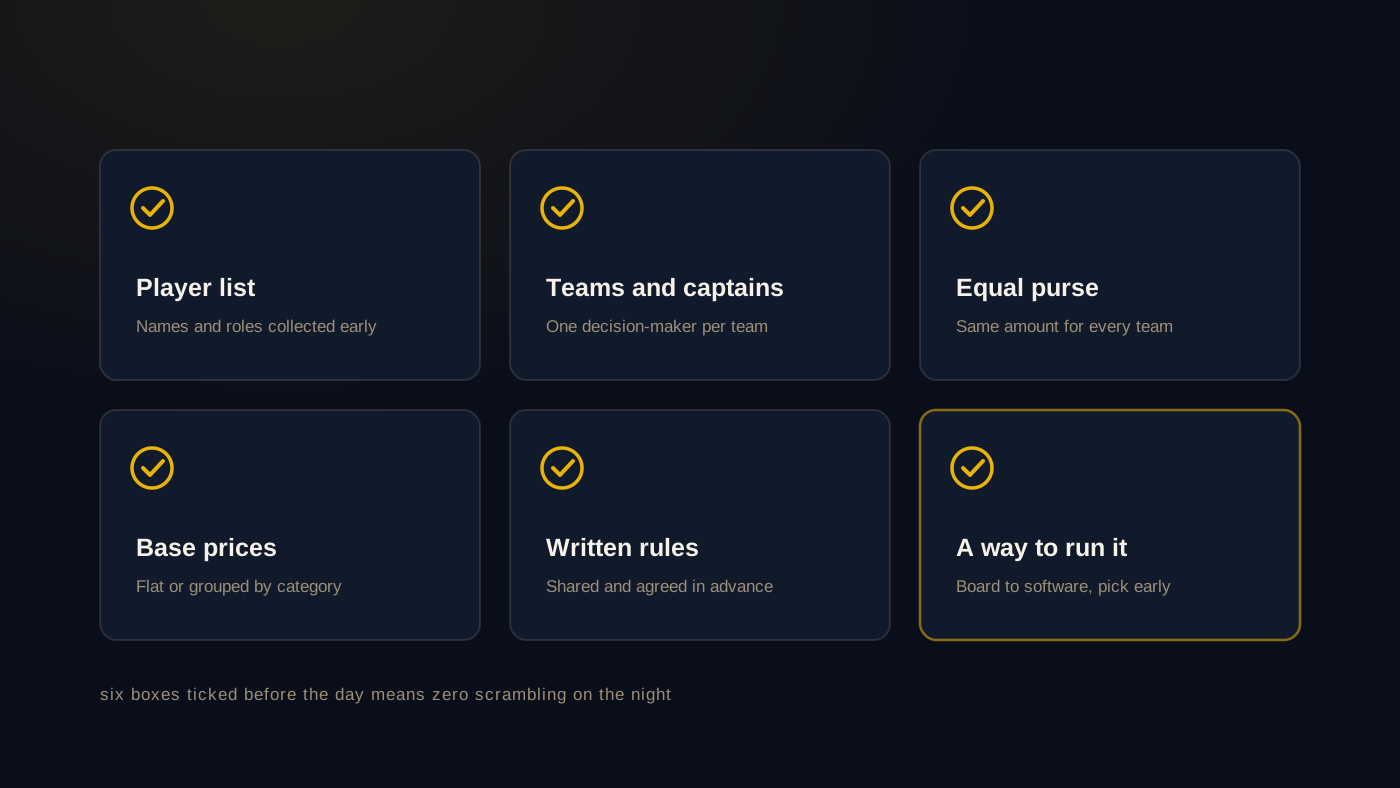
You do not need much, but you do need to prepare. Here is the checklist.
- A player list. Every player who wants to be in the auction, with the basics: name, role, batting or bowling style and anything else your league cares about. Collect it early. Chasing registrations on auction morning is miserable.
- Teams and captains. Decide how many teams you are running and who bids for each one. One clear decision-maker per team keeps bidding fast.
- A purse. The total points or money each team can spend. Every team gets the same amount.
- Base prices. The starting bid for each player. You can give everyone the same base price or group players into categories with different base prices.
- Rules everyone has agreed to. Bid increments, squad size limits and what happens to unsold players. Write them down and share them before the day. We cover these in detail in our complete guide to cricket auction rules.
- A way to run it. This can be a whiteboard and a calculator, a spreadsheet or purpose-built software. Purpose-built tools like AuctionXI track every purse automatically, show the live state on a big screen and remove the arithmetic errors that plague manual auctions.
One honest note on the spreadsheet option: it does work for small auctions. If you have six teams and forty players, a confident operator with a spreadsheet can manage. The pain starts when the room gets loud, bids come fast and one wrong cell breaks every purse total below it. That is usually the point where organisers look for something built for the job.
The four stages of auction day
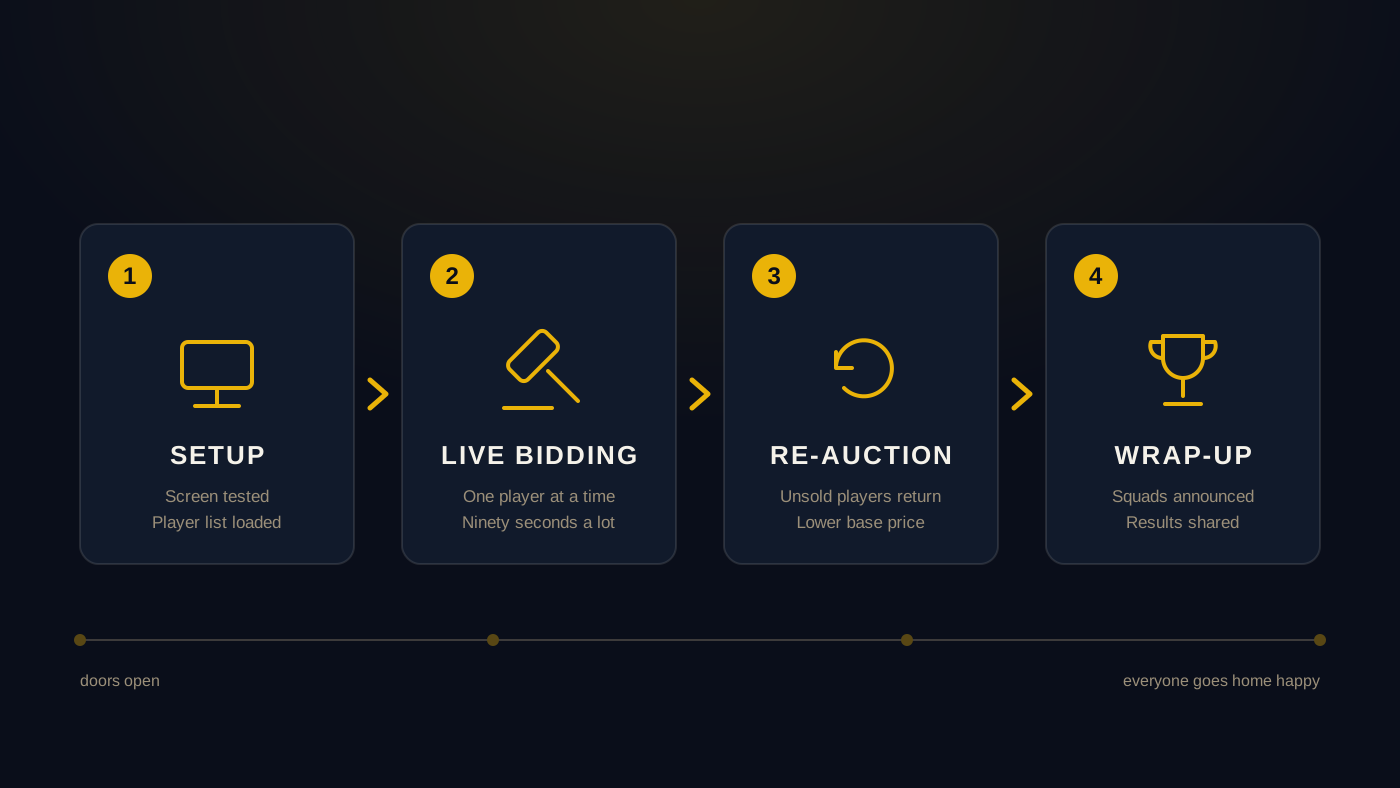
Auction day itself breaks into four stages. Keep them separate in your head and the day runs itself.
Stage one: setup
Before anyone arrives, get the room ready. Test the screen or projector everyone will watch. Confirm every captain knows their purse and the rules. Load your player list into whatever you are running the auction on. If you are using AuctionXI, this is a bulk import from Excel with photos mapped automatically, so the setup that used to take an evening takes minutes.
Stage two: the auction itself
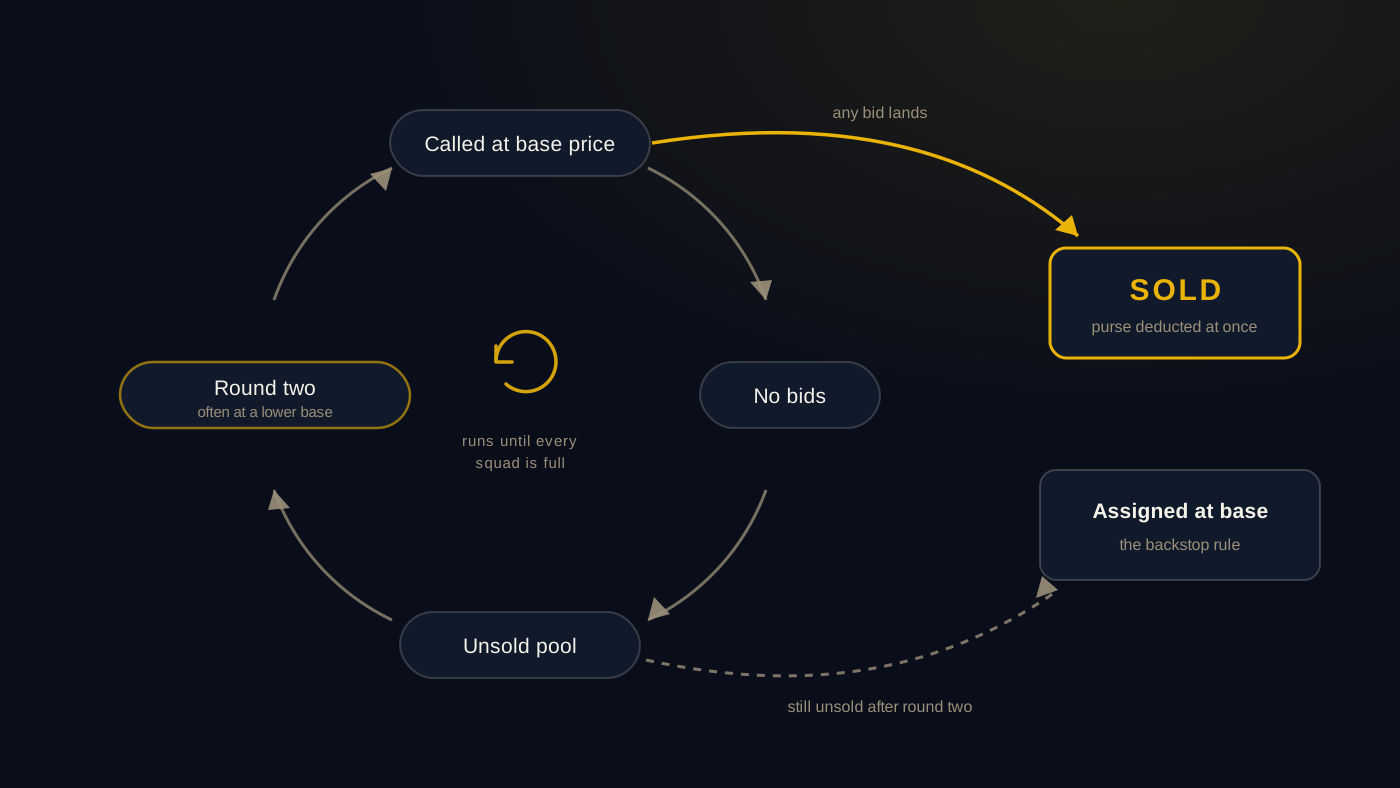
Bring players up one at a time. The auctioneer announces the player, the base price and opens bidding. Captains raise bids by the agreed increment until only one team is left. The auctioneer calls it sold, the purse is deducted and the next player comes up.
Keep the energy up. A good auctioneer teases the room, gives each player a one-line introduction and keeps the pace brisk. A player every ninety seconds is a good target. Slower than that and the room starts checking phones.
Stage three: unsold players and re-auction
Some players will go unsold, and that is normal. Do not skip them and hope nobody notices. Run a second round after the main list is done. Teams with purse and squad space left bid again, often at reduced base prices. Most leagues also allow unsold players to be assigned to short-handed teams at base price at the very end, so everyone who registered gets a team.
Stage four: wrap-up
Announce the final squads, take the team photos and share the results the same night while everyone is still buzzing. If your auction software can export the full results as a workbook, send it to every captain so there are no arguments later about who spent what.
Common mistakes to avoid
Every mistake on this list comes from a real pattern we have seen organisers hit.
- No agreed rules before the day. If the increment rules are invented live, every close bid becomes an argument. Decide everything beforehand and share it in writing.
- Purse maths on the fly. A captain who is told the wrong remaining purse will bid money they do not have. When it unravels, so does the evening. Automate the maths or double-check every total.
- Letting one team spend everything early. Set squad minimums so a team cannot blow the purse on three stars and fill the rest for free.
- No plan for unsold players. Decide what happens to them before the auction, not after.
- A dead room. An auction watched on one laptop by five captains is a meeting. Put it on a big screen, invite the players and let everyone watch their own sale.
A few questions organisers always ask
How long does an auction take? Budget about ninety seconds per player. An eighty-player auction is roughly a two-hour evening with a break.
How big should the purse be? There is no magic number. What matters is the ratio of purse to squad size, so captains face real choices. A common starting point is a purse of about one hundred times the base price for a squad of ten to twelve players.
Can players watch from home? With modern auction platforms, yes. AuctionXI gives you a viewer link that anyone can open on their phone to follow the bidding live, which matters for leagues where players are spread across cities.
Do I need to be technical to run one? No. If you can fill a spreadsheet, you can run an auction. Tools like AuctionXI are built so a first-time organiser can set up a tournament and run the whole event without a technical bone in their body.
Run the preparation properly, keep the four stages in order and protect the fun. That is the whole recipe. The best compliment you can get as an organiser is the one that follows every good auction night: "we are doing this again next year, right?"