The difference between a smooth auction and a chaotic one is almost never the software, the venue or the auctioneer. It is the rules. When every captain knows exactly how bidding works before the first player comes up, the evening runs itself. When the rules are made up as you go, every close call turns into a debate.

This guide covers every rule a cricket player auction needs, why each one exists and the standard choices most leagues make. Use it as a checklist when you write your own rulebook, and share that rulebook with every captain before auction day.
The purse
The purse is the total amount each team can spend across the whole auction. Every team gets the same purse, and that single fact is what makes an auction fair. Nobody buys their way to a stacked squad, because everybody has the same money.
You can denominate the purse however you like. Some leagues use play money in lakhs and crores for the full IPL-style feel. Others use simple points, say 10,000 points per team. The unit does not matter. The ratio does. A purse that is too large relative to base prices means nobody ever runs out of money and every bid war goes on forever. A purse that is too tight means teams stop bidding halfway through. A useful starting point is a purse around one hundred times your standard base price for squads of ten to twelve.
Write into your rules whether unspent purse means anything. In almost every league it does not. It simply expires, which pushes captains to actually spend it.
Base prices
The base price is where bidding starts for a player. There are two common approaches.
- Flat base price. Every player starts at the same amount. Simple, quick to explain and fine for most local tournaments.
- Category base prices. Players are grouped, often as icon, category A and category B, and each group has its own base price. This rewards your stronger players with a higher floor and helps captains plan.
If a player attracts no bids at base price, they go unsold for that round. That is not an insult, it is just sequencing. Captains often pass early because they are saving purse for players further down the list. The re-auction round exists exactly for this.
Bid increments
Increments are the steps bids must rise by, and they are the single most argued-about rule in amateur auctions. Fix them in writing.
The simplest rule is a flat increment: every bid raises the price by a fixed step, say 500 points. Clean and unambiguous.
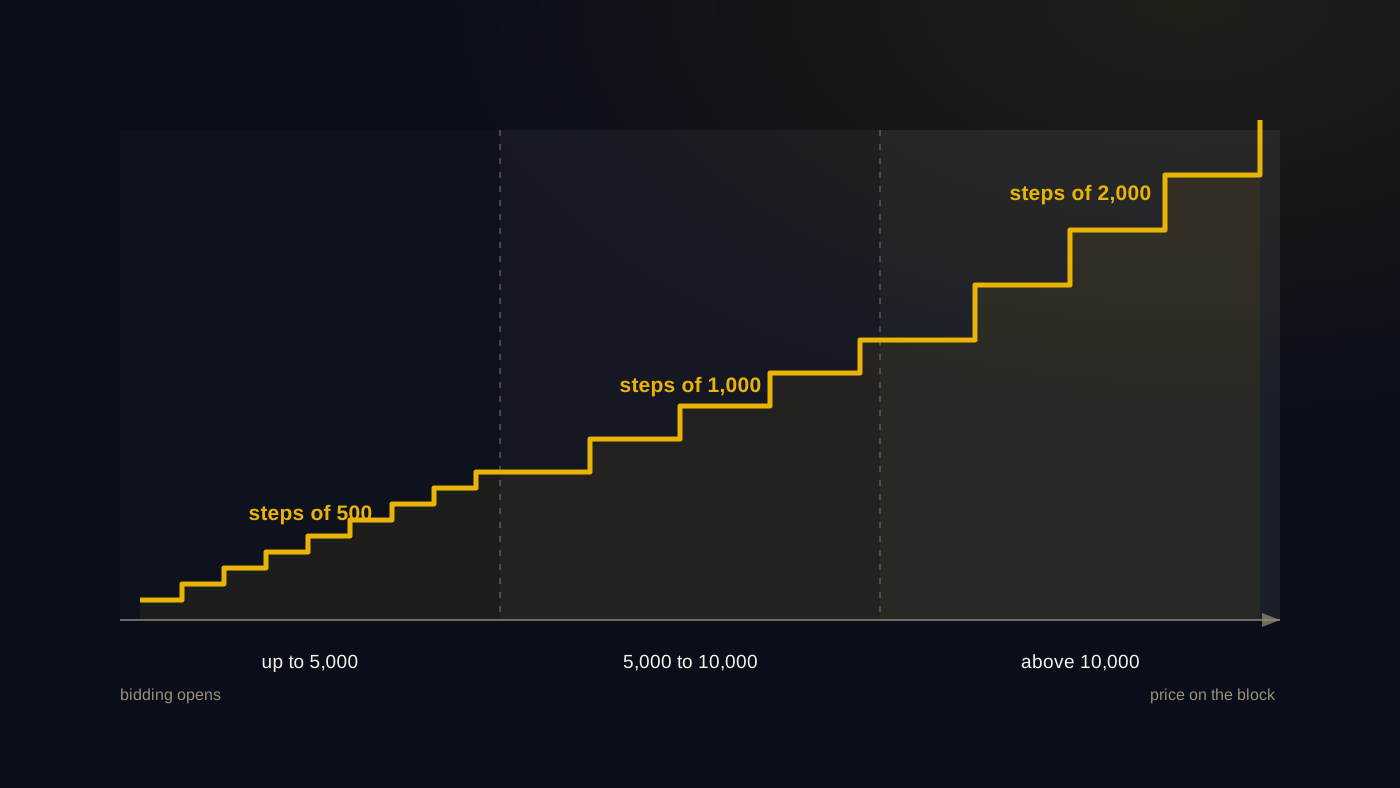
The better rule for bigger auctions is a slab system, the same idea the IPL uses. Small steps at low prices, bigger steps as the price climbs. For example: steps of 500 up to 5,000, steps of 1,000 up to 10,000 and steps of 2,000 beyond that. Slabs stop the endless plus-one bidding that makes a hot player take ten minutes to sell.
Whichever you choose, add two supporting rules. First, a bid once made cannot be withdrawn. Second, the auctioneer's call is final. You need both in writing before the night you need them.
Sold and unsold
A player is sold when the auctioneer completes the call with one team standing. The winning team's purse is immediately reduced by the final price and the player is locked to that squad. Immediately matters. Purse totals that lag behind the actual sales are how teams end up committing money they no longer have.
A player is unsold when no team bids at base price. Unsold players are set aside, not deleted. They come back later.
One more call worth defining: the accidental sale. Auctioneers are human, and sometimes the hammer falls wrong. Decide in advance how corrections work. A short undo window handled by the operator is the cleanest fix. AuctionXI, for instance, gives the operator fifteen seconds to pull back a mistaken sold call, after which the result is final. However you handle it, define it before the auction, because inventing a correction policy mid-argument never goes well.
Re-auction rounds
After the main list is done, run a second round for unsold players. Standard choices for this round:
- Teams may bid on any unsold player, subject to remaining purse and squad space.
- Base prices in the re-auction round are often reduced, sometimes to half.
- The round runs until every team has a full squad or no bids are coming.
Most leagues add a final backstop rule: any player still unsold after the re-auction is allocated to the team with the most open slots at base price, or distributed by draw. If your league promises every registered player a team, write the backstop down. If unsold players stay out, write that down too, and make sure players know before they register.
Squad size caps and minimums
A squad cap is the maximum number of players a team may buy, and it should be matched with a minimum. The pair matters more than either rule alone.
The cap stops a rich team hoarding players. The minimum stops a different problem: a captain who spends the entire purse on three superstars and expects to fill the rest of the squad with free unsold players. With a minimum of, say, eleven players, that captain is forced to spread the purse across the whole squad.
Some leagues add composition rules on top, such as at least three bowlers and one wicketkeeper per squad. These make squads more balanced but slow down bidding, since captains must track more constraints. For a first auction, keep it to a cap and a minimum.
Purse protection
Purse protection is the rule that a team may never bid more than it can afford to complete its squad. It sounds obvious. It is also the rule most manual auctions break, because the maths is fiddly to do live.
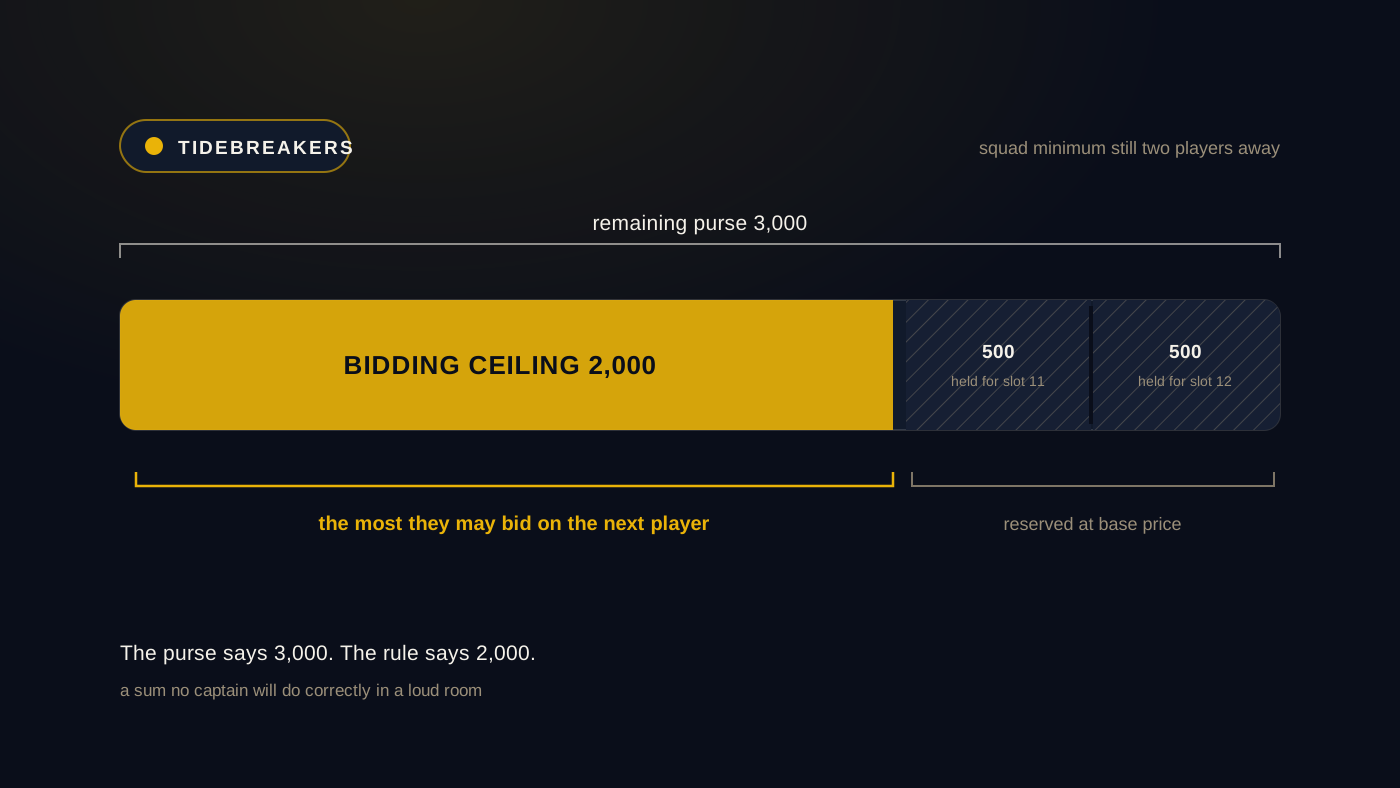
Here is the problem it solves. Suppose the Tidebreakers have 3,000 points left and still need three more players to reach the squad minimum, with a base price of 500. Their true bidding ceiling on the next player is not 3,000. It is 2,000, because they must keep 500 in reserve for each of the two remaining mandatory slots. A captain in a loud room will not compute that under pressure, and an auctioneer with a calculator will not catch it every time.
This is one place where software genuinely earns its keep. AuctionXI enforces purse protection automatically, so a purse can never go negative and a team can never bid itself out of a complete squad. If you run your auction manually, appoint one person whose only job is checking maximum allowable bids before big calls.
Category auctions
Larger auctions often sell players in categories rather than one random list: icon players first, then all-rounders, then batters, then bowlers. Some leagues group by skill tier instead.
Categories help in three ways. Captains can plan purse across the evening because they know when each type of player is coming. The marquee names up front set the energy for the night. And similar players sell near each other, which keeps prices sane because captains can compare like with like.
The order is yours to choose, but announce it in advance along with the player list. A captain saving purse for a star bowler deserves to know the bowlers come last.
Put it all in one page
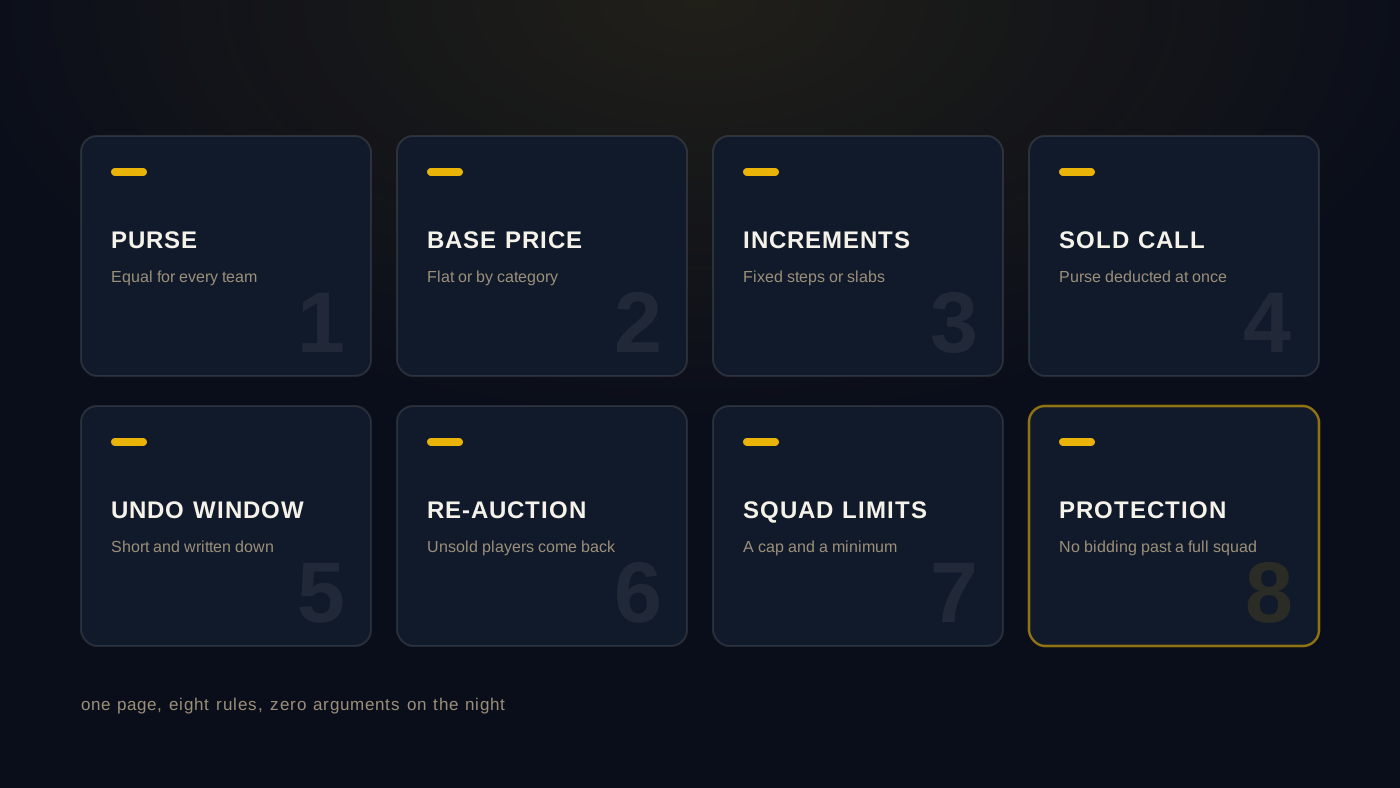
Every rule above fits on a single sheet: purse, base prices, increments, sold and unsold calls, the undo policy, re-auction, caps and minimums, purse protection and the category order. Send that sheet to every captain a week before the auction and have them confirm they have read it.
Do that, and auction night becomes what it should be: captains fighting over players, a room enjoying the show and not a single argument about the rules. If you want the purse maths, the protection rules and the sold calls handled for you, set up your tournament on AuctionXI and spend your evening auctioneering instead of calculating.