
Every player auction runs on three numbers: the base price a player starts at, the purse each team spends from and the increment each new bid must add. Get them right and the bidding feels alive from the first player to the last. Get them wrong and you either watch every player sell at base price in silence or watch three teams run out of money before half the list is done.

The good news is that these numbers are not guesswork. There are simple ratios that work for almost every league, and this guide walks through all three, ending with a full worked example you can copy and adjust.
Base prices: start with categories
The base price is the opening bid for a player. Nobody can bid below it, so it acts as a floor on what a player is worth.
The simplest option is one flat base price for everyone. It is easy to explain and easy to run, and for a small friendly auction it is perfectly fine. Its weakness shows up at both ends of the list. Your best all-rounder opens at the same number as a first-time player, which means the auctioneer spends five minutes walking the price up on a player everyone knew would go big, and your newer players can look unwanted when nobody bids above the floor.
Category-based base prices fix both problems. Group your players into three or four bands before the auction and give each band its own base price. A typical structure looks like this:
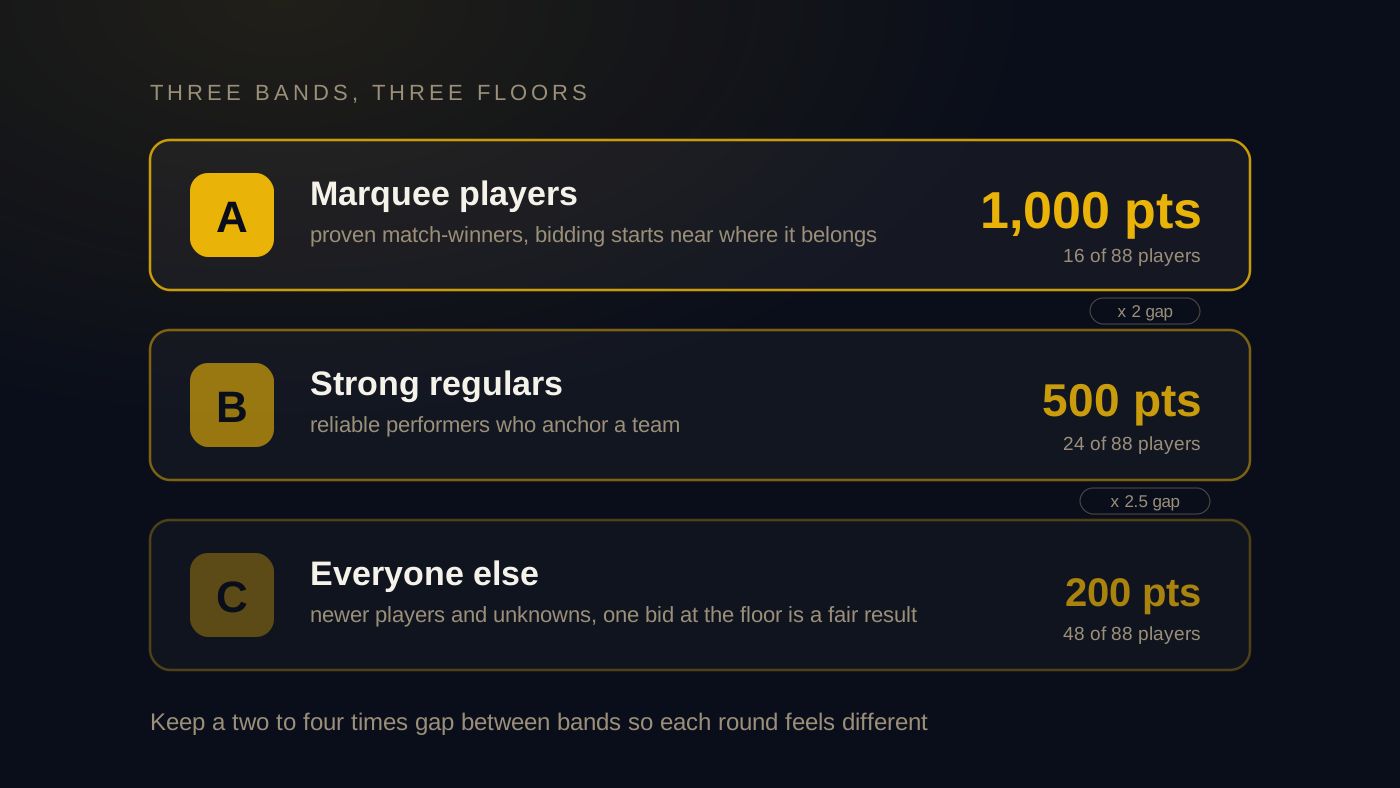
- Category A, the marquee players. Your proven match-winners. High base price, so bidding starts near where it belongs.
- Category B, the strong regulars. Reliable performers who will anchor a team. Medium base price.
- Category C, everyone else. Newer players, occasional players and unknowns. Low base price, so a single bid at the floor is a fair result rather than an insult.
Some leagues add a Category D for juniors or first-timers with a token base price. Three categories is enough for most.
Two rules make categories work. First, decide the categories before registration closes and let a small neutral panel place players, not the captains. Captains grading their own friends is how arguments start. Second, keep the gap between bands meaningful. If Category A opens at 1,000 points and Category B at 900, the categories are decoration. A gap of two to four times between bands gives each one a distinct feel.
The purse: it is a ratio, not a number
Organisers agonise over whether the purse should be 10,000 points or 100,000 points. The honest answer is that the number itself barely matters. What matters is the ratio between the purse and what a full squad costs at base price.
Here is the test. Add up the cheapest possible squad: squad size multiplied by the lowest base price, adjusted for however many players from each category a team is likely to carry. If the purse is enormous compared to that figure, captains never face a real decision and every star sells for silly money. If the purse barely covers it, captains sit on their hands all night protecting the minimum.
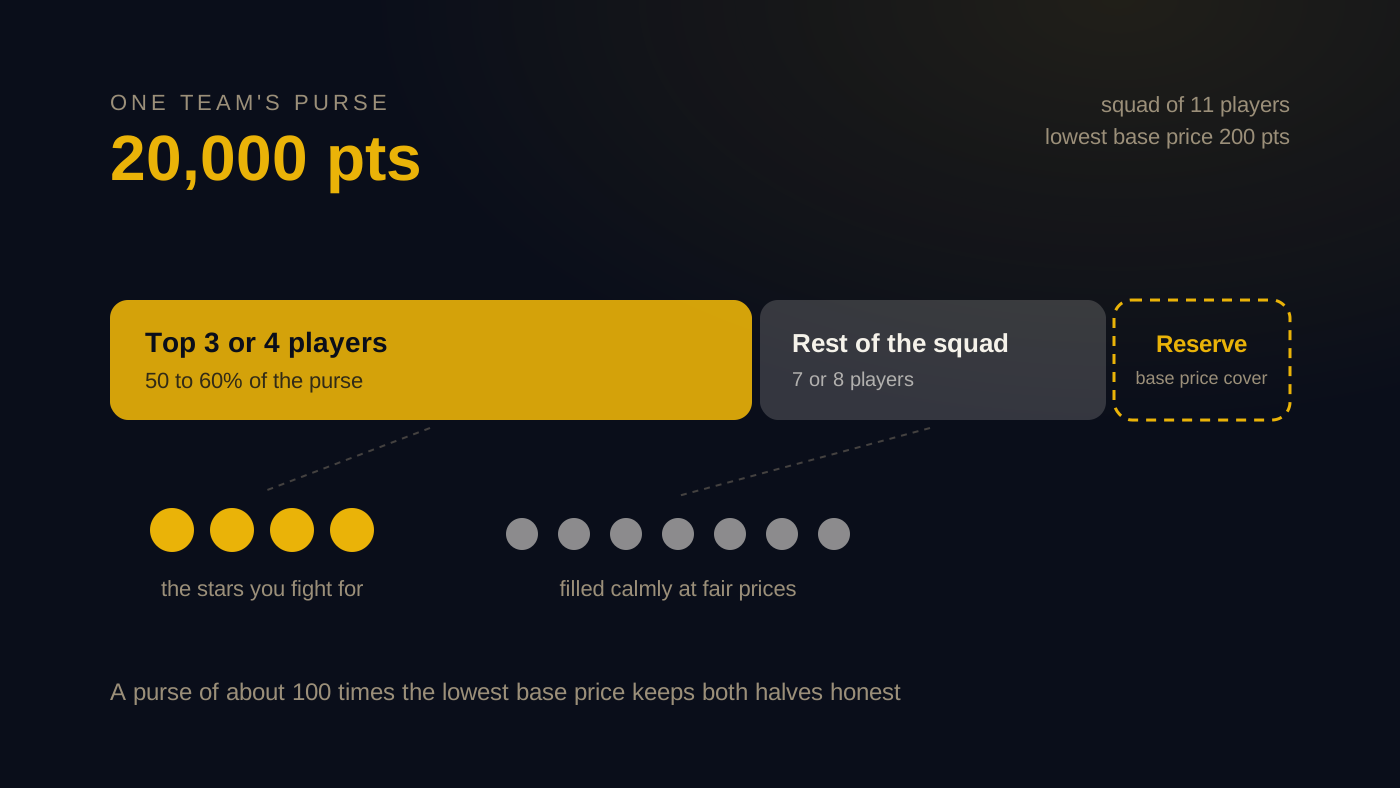
A ratio that works well for most leagues: set the purse so that a team can spend roughly 50 to 60 percent of it on its top three or four players and still comfortably fill the rest of the squad. In practice that usually means a purse of around 100 to 150 times the lowest base price for a squad of ten to twelve.
One more rule, and it is not optional: enforce a reserve. A team must always hold back enough purse to buy its remaining required players at base price. Without this rule, one excited captain buys three stars, runs dry and your auction stalls while everyone renegotiates. With a whiteboard you have to check this by hand after every sale. This is exactly the arithmetic that software does better. AuctionXI tracks every purse to the paisa in real time and simply never lets a team bid money it does not have, so the reserve rule enforces itself.
Bid increments: small steps early, big steps later
The increment is the minimum amount each new bid must add. A single flat increment sounds tidy but plays badly. If the step is small, a marquee player takes forty bids and ten minutes to reach his price. If the step is big, your Category C players jump from affordable to expensive in two bids and go unsold.
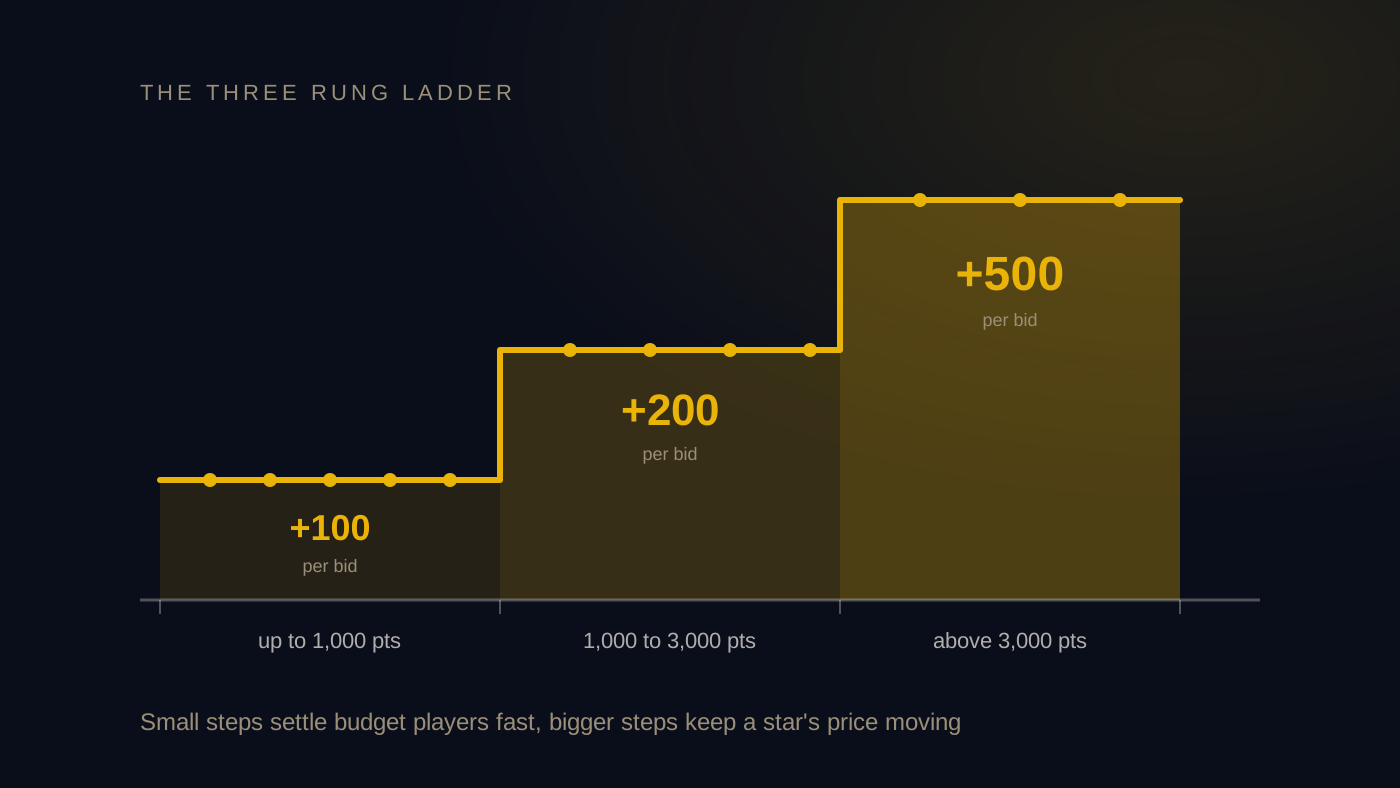
The fix is an increment ladder: small steps at low amounts, bigger steps as the price climbs. This is how the IPL itself runs, and it works just as well at a turf ground. A ladder does two things at once. It lets budget players resolve in a few quick bids, and it lets big bidding wars escalate fast enough to stay exciting.
A simple three-rung ladder is enough:
- Up to twice the base price: small increments.
- From there to five times base price: double the increment.
- Beyond that: double it again.
Whatever ladder you choose, print it, share it with every captain before the day and never invent a rung live. Increment disputes in the middle of a bidding war are the fastest way to kill the room. Our complete guide to cricket auction rules covers how to write these rules up so nobody can claim they did not know.
A worked example: the Riverside Premier League
Let us put all three numbers together for a fictional league. The Riverside Premier League has 8 teams, 88 registered players and a squad size of 11.
Categories. The organising panel grades the list: 16 marquee players in Category A, 24 strong regulars in Category B and 48 in Category C.
Base prices. Category A opens at 1,000 points, Category B at 500 and Category C at 200. Each band is at least double the one below it, so each round feels different.
Purse. The cheapest realistic squad here costs a few thousand points, so the league sets the purse at 20,000 points, which is 100 times the lowest base price. A captain can drop 10,000 to 12,000 points on three or four stars and still fill eleven slots. The reserve rule applies throughout: with six slots still to fill, a team must always hold at least 1,200 points, which is six players at the 200 floor.
Increment ladder. Bids up to 1,000 points move in steps of 100. From 1,000 to 3,000 the step is 200. Above 3,000 the step is 500.
Watch how it plays out. The Stormhawks and the Tidebreakers both want Rehan, a Category A opener. He starts at 1,000, climbs in 200s through the mid range, and once he crosses 3,000 the bids jump in 500s: 3,500, 4,000, 4,500. Sold to the Tidebreakers at 4,500, about a fifth of their purse, in under two minutes. Later, a Category C bowler opens at 200, draws bids of 300 and 400 and sells. Quick, fair and nobody's evening was wasted.
That is the whole system: three categories, a purse at 100 times the floor with a reserve rule and a three-rung ladder.
Questions organisers ask about the numbers
Points or rupees? Points, almost always. Points keep the auction about squad building rather than real money and avoid awkwardness when player fees are a separate matter.
Should unsold players get a lower base price in round two? Yes, commonly half. It gives teams a genuine reason to look again. AuctionXI supports re-auctioning unsold players as a built-in flow, so round two takes seconds to start rather than a reshuffle of paper.
Can I change the numbers mid-auction? No. Changing the purse or the ladder after even one player is sold is unfair to every team that bid under the old rules. If you discover a genuinely broken setting, pause, get every captain to agree in the open and write the change down.
What if my sport is not cricket? Nothing above is cricket-specific. The same ratios run football, volleyball, kabaddi and badminton auctions unchanged. Only the player categories change.
Set the three numbers before registration closes, publish them and then leave them alone. If you want to see where they fit in the bigger picture of the event, start with our guide on how to run a cricket player auction. The numbers are the skeleton. Auction night is the show.