The professional league era changed kabaddi in India forever, and one of the things it changed most is how teams get built. The televised player auction, with franchises fighting over star raiders while the purse ticker falls, is now as famous as the sport itself. Local kabaddi leagues have noticed. Society tournaments, village leagues and college championships are swapping the old captains' huddle for a proper live auction, and the format fits kabaddi beautifully.
This guide covers what makes a kabaddi auction different from any other sport: how to build your categories around raiders and defenders, how to size a purse for a squad of ten to twelve and what captains in your league will fight over on the night.
Why kabaddi and auctions are a perfect match
Kabaddi is a sport of specialists. Seven players take the mat, but those seven are not interchangeable. A team that ends up with five raiders and two defenders is broken before the first whistle, and everyone in the hall knows it. That is exactly the kind of selection problem an auction handles well.
With a fixed purse and open bidding, every captain faces the same puzzle: how much of the budget goes on a lead raider, how much on the corners and what is left for the bench. Watching a captain blow half the purse on a star raider and then scramble for defenders is half the entertainment. It also produces balanced teams, because no captain can hoard all the talent when every rupee spent on one player is a rupee unavailable for the next.
There is a fairness point too. In most local leagues, one or two captains know every player in the area. Manual picking quietly rewards them. An auction puts every player on the block in front of the whole room, and the mat settles the rest.
Build your player pool around kabaddi roles
Before you think about money, sort your registered players into the three categories every kabaddi follower understands.
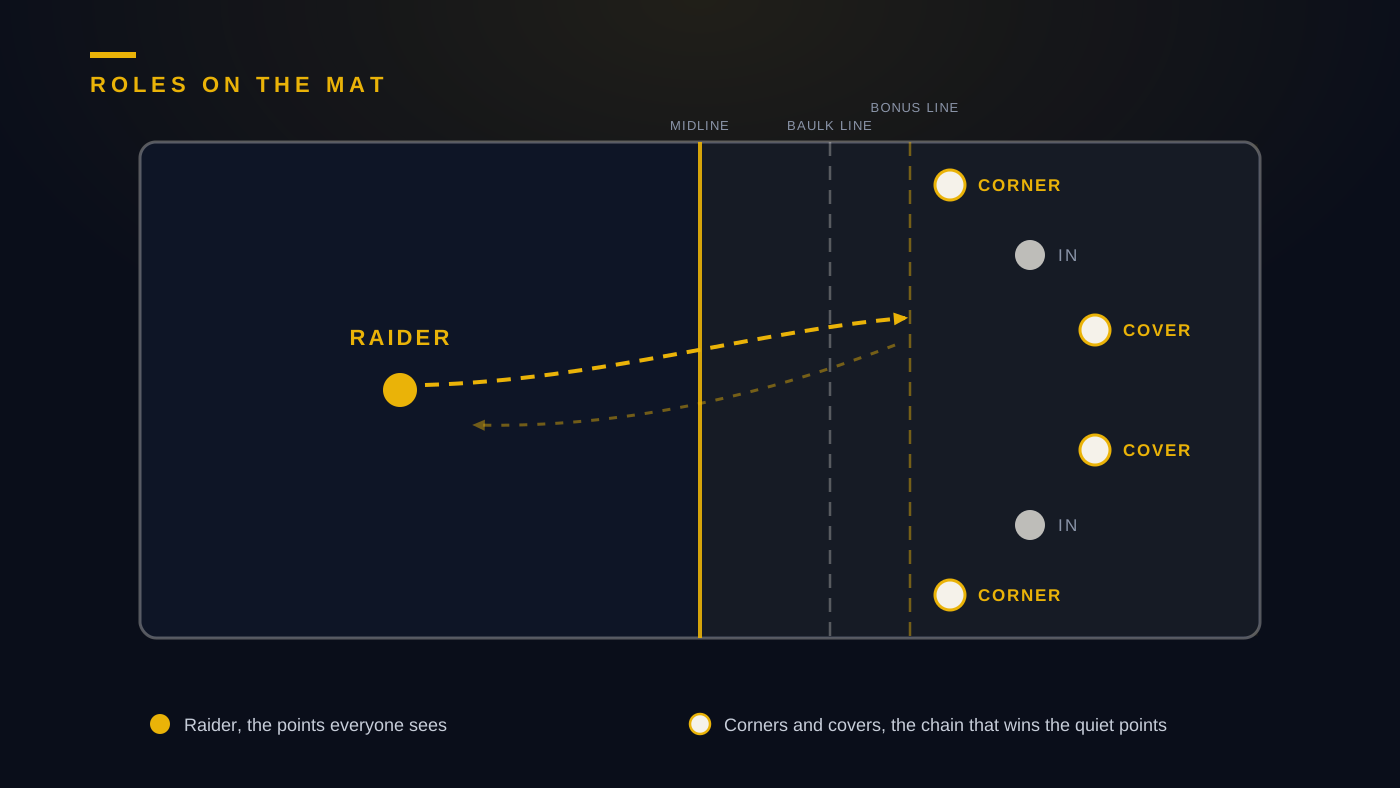
- Raiders. Your point scorers. Note whether each one is a bonus-line specialist, a strong hand-touch raider or a do-or-die specialist who can be trusted when the raid clock forces a point attempt.
- Defenders. Split them further if your pool is big enough: corner defenders who ankle-hold and block at the edges of the mat, and cover defenders who read the raid and organise the chain. Corners and covers are different jobs, and captains bid differently for them.
- All-rounders. Players who can raid in the first half and drop into the defensive chain in the second. In a squad of ten to twelve, a genuine all-rounder is insurance against injuries and all-outs, and experienced captains know it.
Collect this information at registration, not on auction night. Ask each player to declare a primary role and one honest line about their game. Our guide to player registration for auctions covers the forms and follow-ups that make this painless.
One practical note: generic auction tools and cricket spreadsheets will label your players with batting averages and bowling styles, which is useless on a kabaddi mat. This is where purpose-built software earns its place. AuctionXI lets you rename every player field for your sport, so your auction screen shows raid points, tackle points and do-or-die success instead of runs and wickets, and the bulk Excel import brings your whole pool in with photos mapped automatically.
Squad size and purse planning for kabaddi
Seven players start on the mat, and substitutions plus the risk of injuries in a contact sport mean you should never auction squads of seven. Ten to twelve per team is the sweet spot: seven starters, three to five substitutes and enough depth that one twisted ankle does not end a team's tournament.
For the purse, the ratio matters more than the number. A workable starting point is a purse of around one hundred times your base price for a squad of twelve. That leaves room for two or three marquee buys while forcing real choices at the back end of the auction. Set a squad minimum as well, so no captain can spend everything on three stars and demand free players later. The full maths, with worked examples, is in our guide to base prices, purse and bid increments.
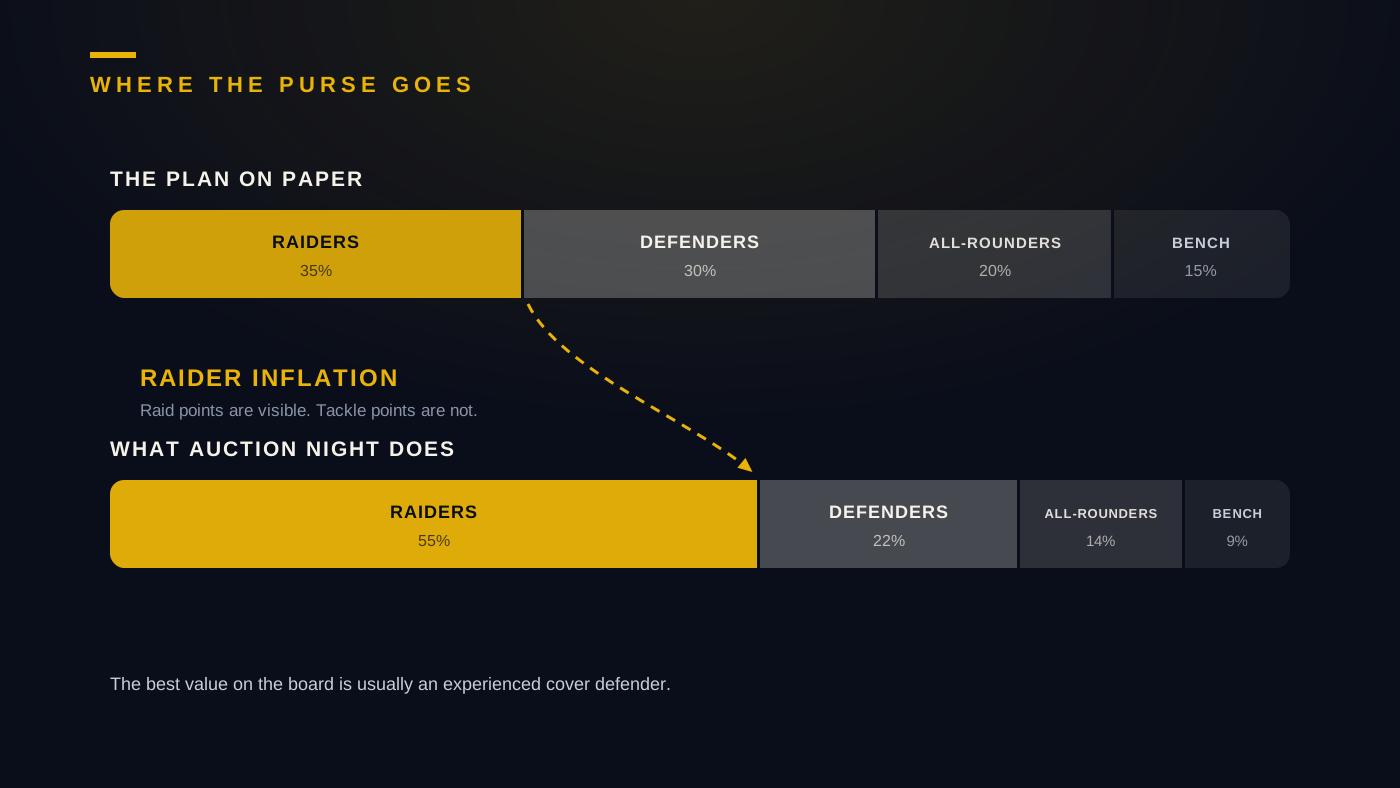
A kabaddi-specific warning: expect raider inflation. In almost every local kabaddi auction, the top two or three raiders go for far more than any defender, because raid points are visible and tackle points are not. Smart captains budget for this. Some of the best value on the board will be an experienced cover defender who marshals the whole chain, going for a fraction of what a flashy raider costs.
Running the auction night
Kabaddi crowds are loud, and that is a gift. Lean into it.
- Order the list for drama. Do not start with your biggest raider. Open with solid mid-tier players so captains find their rhythm, bring the stars out once the room is warm and save one crowd favourite for late.
- Give every player a line. "Right corner, three seasons with the Matpur Mavericks, famous for the super tackle in last year's final" takes ten seconds and doubles the bidding.
- Alternate roles. Run a few raiders, then a few defenders, then all-rounders. If all raiders sell first, teams that missed out stop bidding and the room goes flat.
- Put it on a big screen. Kabaddi auction night should feel like the televised version. A projector showing the current player, the live bid and every team's remaining purse keeps the whole hall in the game, and players following from home can watch on a phone link. Our guide to broadcasting your auction on a projector or YouTube covers the setup.
Keep the arithmetic away from humans. When bids jump in a noisy hall, an operator with a calculator will make mistakes, and a captain told the wrong remaining purse will bid money that does not exist. AuctionXI tracks every purse to the paisa, will not let a team go negative and gives the operator a fifteen-second undo when a bid is recorded wrong, which happens in every loud auction at least once.
Handling unsold players and the final rounds
Some players will go unsold in round one. In kabaddi this is usually the third-choice defenders and the raiders nobody has seen play. Do not let them drift. Announce before the auction that unsold players return in a second round at a reduced base price, and that teams below the squad minimum must fill their slots there. Run that round with the same energy as the first. A player picked up in the unsold round who tops the tackle chart is one of the great stories a league can produce.
Questions kabaddi organisers ask
How long will the auction take? For a typical league of eight teams and ninety-odd players, budget around two hours with a break. Ninety seconds per player is a good pace.
Should defenders and raiders have different base prices? You can, and many leagues do, with raiders starting slightly higher. But a single base price with category-wise ordering works fine too, and it lets the market decide what defence is worth.
What if two teams both need a left corner and only one is left? Enjoy it. That is the auction working. Scarcity within a role is what produces the bidding wars people talk about for months.
Do I need special software? You need something that will not fall over when the room gets loud. If a spreadsheet operator loses one purse total, the evening unravels. A tool built for auctions, with kabaddi-friendly custom fields and a live screen for the hall, costs less than the trophies and you pay once per tournament rather than a subscription.
Get the categories right, protect the purse maths and let the crowd do the rest. Kabaddi gave India the most watchable auction format in sport. Your league deserves the same night.