
Box cricket is where India actually plays cricket. Not on maidans with proper pitches, but inside netted boxes on society podiums, terrace turfs and indoor arenas, six to eight a side, five to eight overs an innings, done in forty-five minutes. Society leagues and corporate box tournaments have exploded, and the smartest ones now start with a player auction, because nothing launches a tournament like an auction night.

But here is the thing organisers miss: box cricket is not small cricket. Its rules quietly invert what players are worth, and a captain who bids with regular-cricket instincts will build a losing squad. This guide covers the box-specific decisions: squad sizes, the everyone-bowls effect, tape ball versus leather and how to run the whole auction in one short evening.
Squads of six to eight change the shape of the auction
Most box formats play six, seven or eight a side. Add one or two substitutes and your auction squad is seven to ten players. That has three consequences.
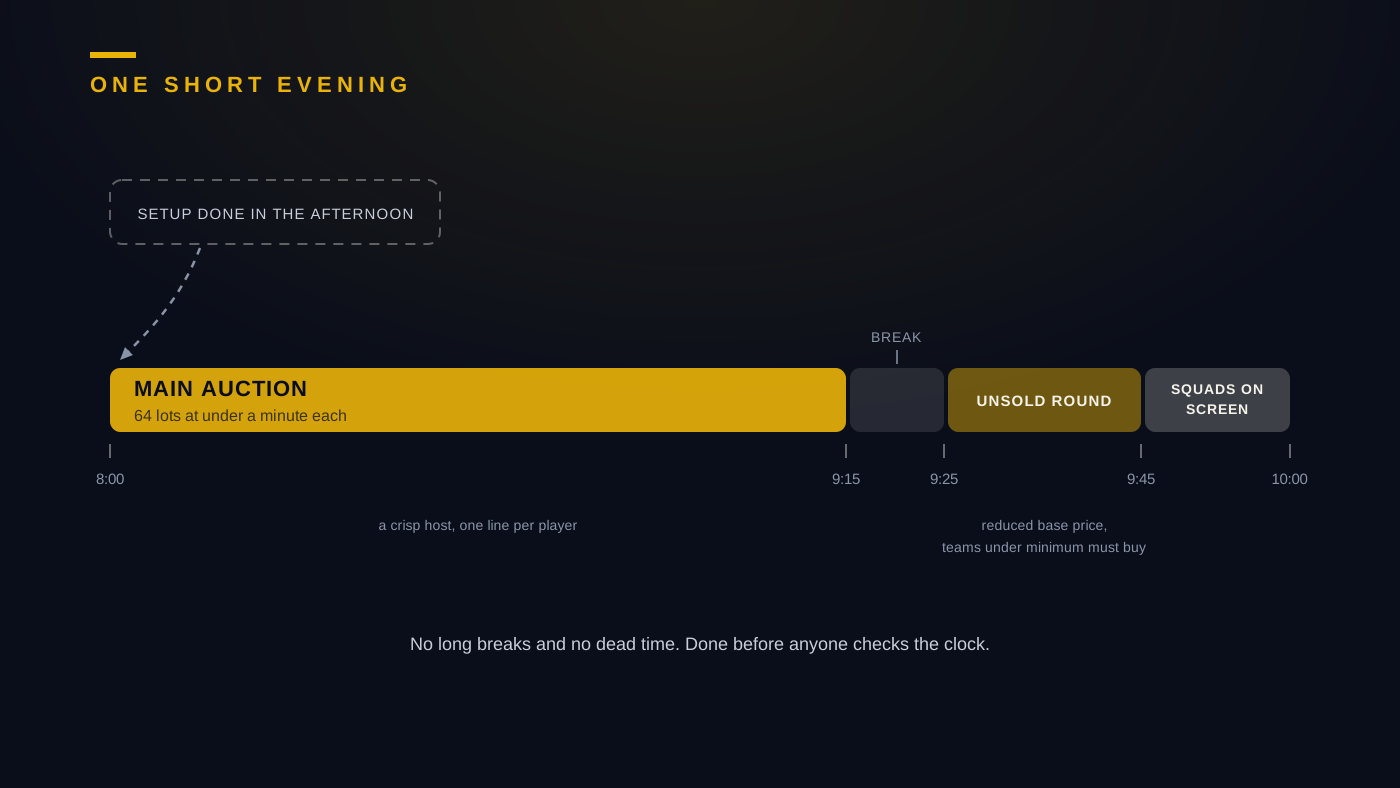
First, the auction is short. Eight teams of eight is sixty-four lots, which at a brisk pace is under ninety minutes of bidding. Box cricket auctions are perfect weeknight events, and you should schedule them that way: start at eight, done by ten.
Second, every pick matters. With eight players a side there is no number eleven to hide. One passenger in a box cricket team is an eighth of the side.
Third, purses should be modest. A purse of around sixty to seventy times base price for a squad of eight gives captains one or two statement buys and hard choices after that. Bigger ratios just inflate prices. Set a squad minimum so nobody hoards stars and then fills up with base-price leftovers.
The everyone-bowls rule rewrites player value
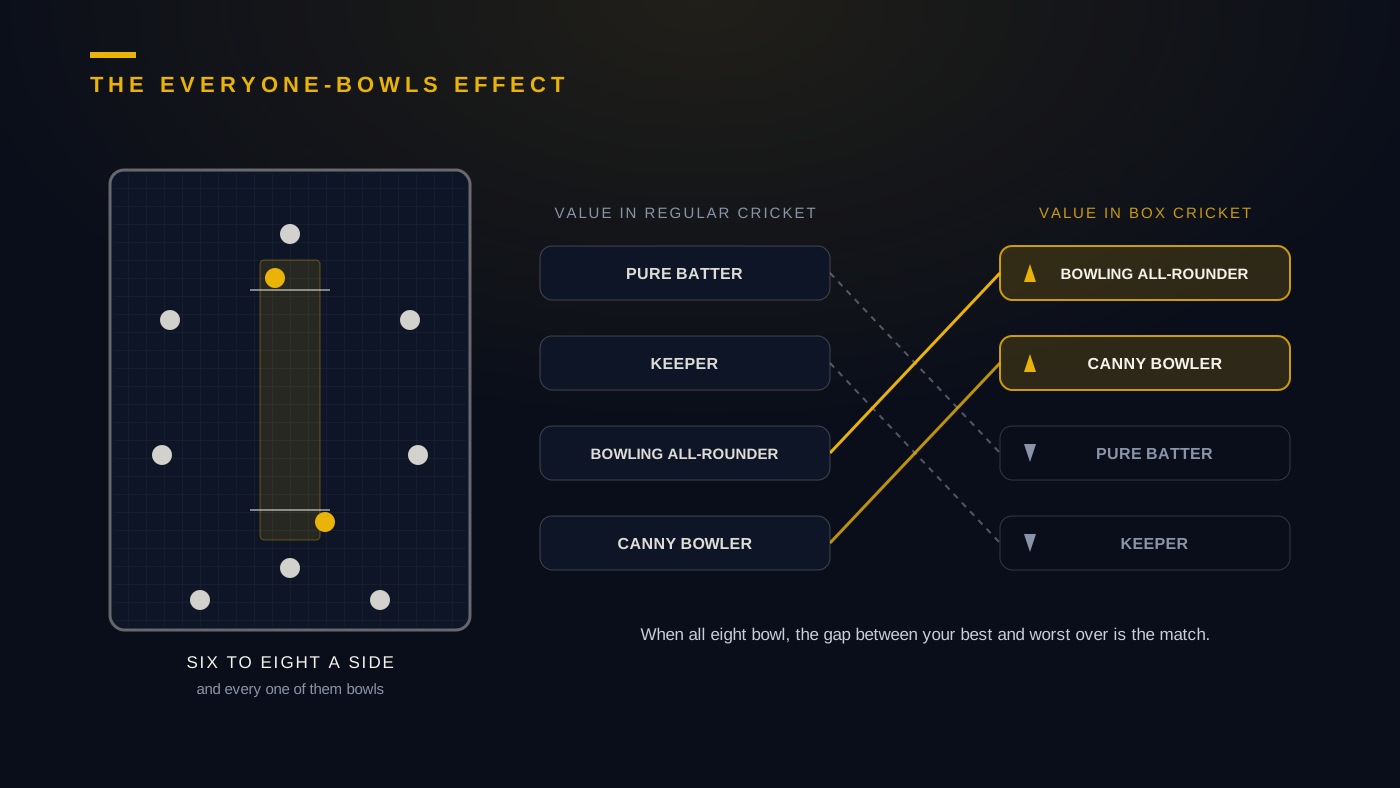
Most box cricket leagues run some version of the compulsory bowling rule: in a six or eight over innings, no bowler bowls more than one over, or every player except the keeper must bowl. It exists to keep the game social, and it completely changes the auction.
In regular cricket, a pure batter who cannot bowl is a fine pick. In box cricket he is a guaranteed leaked over. When all eight players must bowl, the gap between your best and worst over is the match, and the opposition will feast on the weak ones. Meanwhile the bowling all-rounder who bats a bit becomes the most valuable species in the pool.
Brief your captains before bidding starts, because first-timers will pay big for the society's famous six-hitter and then discover his over goes for eighteen. The box cricket hierarchy of value looks like this:
- All-rounders who can bowl a tight over and hit. The premium category. Expect the bidding wars here.
- Canny bowlers. Slower balls and darts into the pads win box games. A bowler who bats at nine in regular cricket can be a top-four pick in a box auction.
- Big hitters. Still valuable, boundaries come fast in a box, but their price should reflect the over they must bowl.
- Wicketkeepers. Far less important than in regular cricket. Many box formats barely need a specialist keeper, so do not let anyone import big-league keeper premiums into your auction.
If your league exempts the keeper from bowling, flag it, because it changes the keeper's price too.
Tape ball or leather: say it before the auction
Box cricket splits into tribes: tennis ball, tape ball and occasionally leather on indoor turf. Announce which one your league plays before the auction, because the ball changes who is good.
Tape and tennis ball reward wrist speed, improvised hitting and bowlers with disguised slower balls, and they neutralise classical technique. The elegant club batter who times leather through covers may be ordinary against tape, while the fearless slogger nobody rates in nets cricket is suddenly a star. Captains who know the pool's tape-ball reputations hold a real edge, which is exactly the kind of local knowledge that makes auction night fun.
This is also where your player list earns its keep. Regular cricket stats mislead in a box, so collect box-relevant information at registration: bowling style, can bowl the compulsory over yes or no, batting position preference and last season's box performances if your league tracks them. Purpose-built auction software helps here: AuctionXI lets you rename player fields per tournament, so the auction screen can show exactly the stats box cricket cares about, imported in bulk from Excel with player photos mapped automatically.
Society and corporate leagues: know your room
Box cricket auctions come in two flavours and the night should be designed for the right one.
Society leagues. Wing versus wing, tower versus tower. Everyone knows everyone, the crowd includes families and the auction doubles as a community event. Hold it in the clubhouse or the podium itself, put the auction on a big screen and let the whole society watch. The energy of an aunty cheering a bidding war for her son is unbeatable. Our office and society auction guide covers the community-event side in detail.
Corporate leagues. Department teams, an HR budget and a weekday evening slot. Keep it tight, ninety minutes, and make it look professional: a projector scene with live purses, sponsor slides between rounds for the internal sponsor and a viewer link that remote employees can open on their phones with no viewer cap.
In both cases the operational rules of any cricket auction still apply: agreed increments, a written plan for unsold players and a re-auction round so everyone who registered ends up in a team. Our complete guide to cricket auction rules covers those fundamentals, and the general four-stage structure from our cricket player auction guide works for box cricket unchanged, just compressed.
Running the short evening auction
A box cricket auction should feel like box cricket: quick, loud and over before anyone checks the time.
- Set up in the afternoon. Import the player list, configure teams and purses and test the projector before the crowd arrives.
- Pace at under a minute per player. Small squads mean captains decide fast. A crisp host with one line per player keeps it moving.
- Automate the purse maths. Fast bidding in a loud clubhouse is where manual tracking breaks. A platform that tracks every purse to the paisa, refuses to let a team go negative and offers a fifteen-second undo for mis-entered bids removes the arguments before they start.
- Run the unsold round immediately. No long break. Reduced base price, teams below minimum must buy, done.
- Close with the squads on screen. Team photos, final rosters and the exported results workbook in the league group the same night.
Questions box cricket organisers ask
Can we auction multiple divisions in one night? Yes, if you keep each division's pool and purses separate. Two sixty-lot divisions is still under three hours.
What about players who registered late? Add them to the unsold round at base price. Do not slip them into the main list mid-auction, it muddles captains' planning.
Is software worth it for a tournament this small? The smaller and faster the auction, the more a mistake costs, because there is no time to untangle it. A tool where you pay once per tournament rather than a subscription fits box league budgets, and the setup takes less time than printing the fixtures.
Box cricket is the most democratic cricket there is: everyone bats, everyone bowls, everyone fields in a space the size of two badminton courts. Run an auction that honours that. Value the all-rounders, brief the captains on the compulsory over and keep the whole night as quick as an eight-over chase.