
Every city in India now has its turf scene: floodlit artificial pitches booked by the hour, weeknight games that kick off at nine and end at midnight, WhatsApp groups where a "who's in for Thursday" message gets forty replies. Sooner or later, every turf group graduates from pickup games to a proper league. And the best way to pick league teams is the way every football fan secretly wants: a live player auction.

This guide covers auctions for small-sided football specifically, the 5-a-side and 7-a-side formats that turf leagues actually play, because they change squad building in ways a full-pitch template misses.
Know your format before you set squad sizes
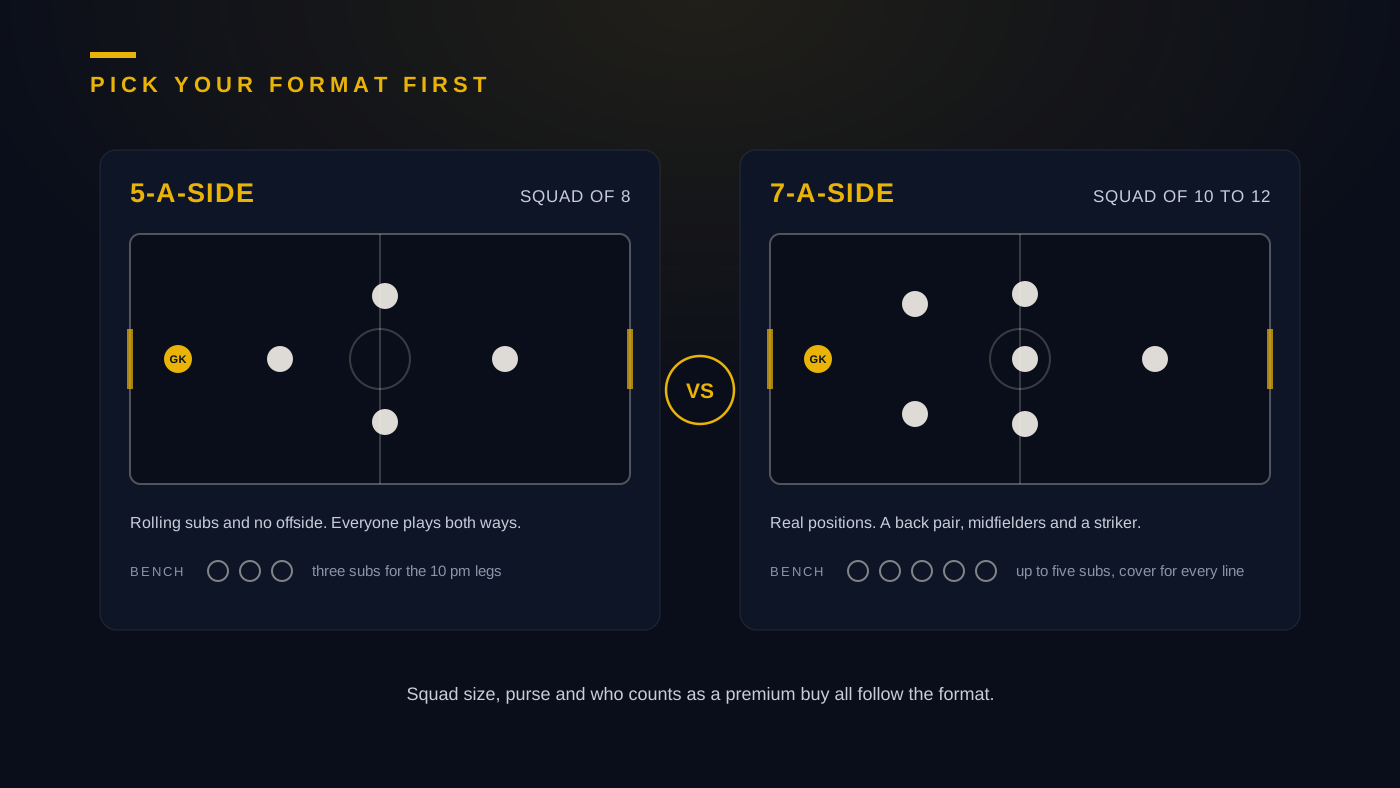
5-a-side. One goalkeeper and four outfielders, usually with rolling substitutions, no offside and kick-ins or rebound boards instead of throw-ins. Games are short and relentless, so everyone plays both ways. A sensible auction squad is eight: five starters and three subs, because turf football with no subs at 10 pm is a fitness test nobody passes.
7-a-side. One goalkeeper and six outfielders on a bigger turf. Positions actually exist here: a back pair, midfielders and a striker who can stay high. Auction squads of ten to twelve work well.
Decide the format first, because everything downstream, categories, purse and even who counts as a premium player, depends on it.
Categories: and why the goalkeeper rules the market
Sort your registered players into position categories:
- Goalkeepers. More on them in a second.
- Defenders. In 5s this means the player who actually tracks back when everyone else is admiring their own nutmeg. In 7s it is a real position.
- Midfielders. The engines. In small-sided football the player who can receive under pressure, keep the ball and run all night is worth more than any finisher, and good captains know it.
- Forwards. The finishers and the flair. They will attract the loudest bids.
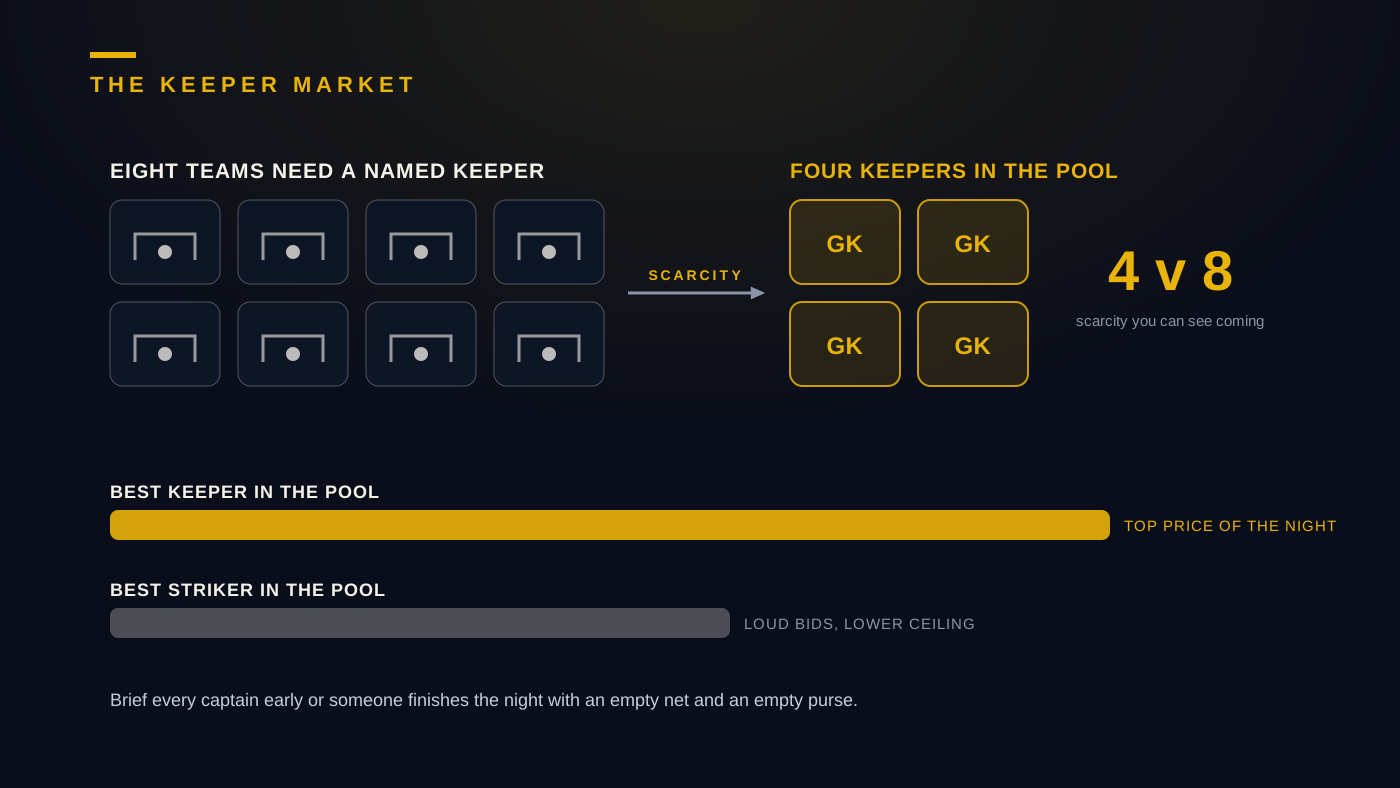
Now, goalkeepers. Every turf organiser knows the truth: nobody registers as a keeper. Out of sixty registrations you might get four genuine goalkeepers, and your league rules almost certainly require a designated keeper per team. Four keepers, eight teams: that is the most predictable bidding war in sport. Expect the best keeper in the pool to go for more than the best striker, and brief your captains so nobody is caught with an empty net and an empty purse.
Two ways to manage keeper scarcity. Either let the market run, which is dramatic and fair, or auction the goalkeeper category first with a higher base price so teams settle the scarcest slot before spending elsewhere. If you genuinely have fewer keepers than teams, decide in advance how the short teams cover the position, usually by nominating an outfielder, and write it into the rules.
Registration is where all of this gets captured: position, preferred foot and one line of football honesty, collected well before auction night so nobody is filling forms at the door. And when you load the pool into your auction tool, rename the player fields to fit football. AuctionXI lets you define custom fields per tournament, so the screen shows position, preferred foot and goals last season instead of leftover cricket stats, with the whole list imported from Excel and photos mapped automatically.
Purse maths for small-sided football
For an eight-player 5-a-side squad, a purse of around seventy times base price gives captains two marquee buys and real decisions afterwards. For 7s squads of eleven, stretch it to around a hundred times base price. Set a squad minimum so every team leaves with a full roster and enforce it in the rules.
What will captains overpay for? Finishers. Every turf league has a player famous for scoring in pickup games, and his price will fly. The value picks are the defensive midfielder who wins the ball back all night and the calm defender who never gets dribbled. A quiet word to first-time captains: in small-sided football, the team that concedes least wins the league, and the players who stop goals go cheap.
One rule worth borrowing from bigger auctions: steeper bid increments at the top end. When two captains both need the last good keeper, small increments make the war last ten minutes. Bigger steps keep it exciting and quick.
Auction night for a weeknight league
Turf league culture is weeknight culture, so design the auction for it: one evening, two hours, done. A café, an office cafeteria or the turf's own seating area all work.
- Prepare like a match. Player list loaded, teams and purses configured, projector tested before anyone arrives. Run through our auction day checklist that afternoon and the evening runs itself.
- Big screen, phone links. Put the live auction on a projector: current player, photo, live bid, every team's remaining purse. Players who cannot make it follow on a phone viewer link with no cap on viewers. If your league has a YouTube channel for match highlights, a transparent overlay of the auction state over a camera feed makes the night look properly professional. Setup details are in our guide to broadcasting your auction on projector and YouTube.
- Pace it like small-sided football. Fast. A player a minute. Sixty players in an hour and a quarter, a break, then the unsold round.
- Handle the unsold round generously. Players unsold in round one come back at a reduced base price, and teams under the squad minimum must buy. Everyone who registered plays. In a community league, that rule matters more than any other.
- Mind the money. Loud room, quick bids, beer optional: this is exactly where manual purse tracking dies. Software that tracks every purse to the paisa, blocks negative purses entirely and gives the operator a fifteen-second undo for the inevitable mis-click keeps the night friendly.
End the evening properly: announce squads, take team photos against the turf fence and export the full results workbook to the league group before everyone rides home.
Sponsors love turf leagues
Turf leagues have something most local tournaments lack: a young, regular, local audience. The sports shop near the turf, the café where everyone eats after games and the turf owner himself are all natural sponsors, and auction night is the single best moment to showcase them, with every player and captain in one room staring at one screen. Full-screen sponsor scenes between auction rounds and a scrolling sponsor strip during bidding cost you nothing to run and give sponsors a reason to come back next season. Our guide to getting sponsors for a local tournament covers how to pitch them.
Quick answers for turf organisers
How many teams can one auction handle? Standard plans on most platforms cover typical league sizes comfortably. AuctionXI supports up to twenty teams on standard plans, which is bigger than almost any turf league, and larger events on request.
Mixed-ability pools? Use category-wise base prices: an A pool and a B pool with different starting bids. It keeps bids realistic at both ends.
What does it cost? Purpose-built auction tools are typically a one-time payment per tournament rather than a subscription, so a league that runs two seasons a year pays per season, not per month.
Small-sided football is the fastest game your players know. Give them an auction night with the same energy: tight squads, a scarce-keeper market, a big screen and a finish before midnight. The Thursday group will never pick teams any other way again.